An official website of the United States government
 United States Department of Labor
An official website of the United States government
United States Department of Labor

The .gov means it's official.
Federal government websites often end in .gov or .mil. Before sharing sensitive information,
make sure you're on a federal government site.

The site is secure.
The
https:// ensures that you are connecting to the official website and that any
information you provide is encrypted and transmitted securely.
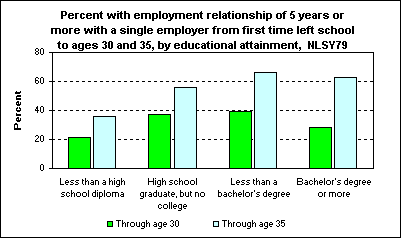
Data from the National Longitudinal Survey of Youth 1979 (NLS79) show that individuals with a high school diploma or higher were more likely to have had an employment relationship lasting at least 5 years by age 30 or 35 than were high school dropouts.
Even though high school dropouts left school the earliest, were in the labor market for the longest time—and therefore had the most time to start down a career path—they were the least likely to have had lengthy employment relationships. Only 36 percent of high school dropouts had held a job for 5 years or more by age 35.
In contrast, those with at least some college or a bachelor’s degree made the transition to lengthier employment relationships the fastest. By age 35, 66 percent of those with some college and 63 percent of those with a college degree had held a job for 5 years.
These data are from the BLS National Longitudinal Surveys program. For additional information, see "The transition from school to work: education and work experiences," by Julie A. Yates, Monthly Labor Review, February 2005.
Bureau of Labor Statistics, U.S. Department of Labor, The Economics Daily, Education and duration of employment relationships at https://www.bls.gov/opub/ted/2005/mar/wk1/art04.htm (visited May 19, 2024).