An official website of the United States government
 United States Department of Labor
An official website of the United States government
United States Department of Labor

The .gov means it's official.
Federal government websites often end in .gov or .mil. Before sharing sensitive information,
make sure you're on a federal government site.

The site is secure.
The
https:// ensures that you are connecting to the official website and that any
information you provide is encrypted and transmitted securely.
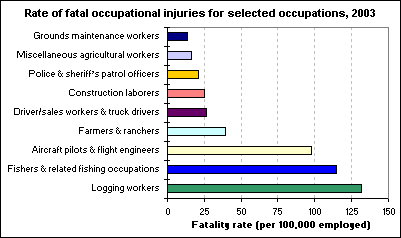
Individual occupations with particularly high rates of fatal work injuries in 2003 included logging workers (131.6 fatalities per 100,000 workers), fishers and related fishing occupations (115 per 100,000), and aircraft pilots and flight engineers (97.4 per 100,000).
The rate of fatal on-the-job injuries for all workers was 4.0 fatalities per 100,000 workers in 2003.
Other occupations with rates far above the average for all workers were farmers and ranchers (39.3 per 100,000), driver/sales workers and truck drivers (26.7 per 100,000), and construction laborers (25.1 per 100,000).
These data on fatal work injuries come from the Census of Fatal Occupational Injuries (CFOI), part of the BLS Injuries, Illnesses, and Fatalities program. Additional information is available from "National Census of Fatal Occupational Injuries in 2003" (PDF) (TXT), news release USDL 04-1830.
Note on occupation classification: Beginning with the 2003 reference year, CFOI began using the Standard Occupational Classification system (SOC). Prior to 2003, the program used the Bureau of the Census occupational classification system. Because of the substantial differences between the current and previous systems, the results by occupation in 2003 constitute a break in series, and users are advised against making comparisons between the 2003 occupation categories and the results for previous years.
Bureau of Labor Statistics, U.S. Department of Labor, The Economics Daily, Fatal work injuries by occupation, 2003 at https://www.bls.gov/opub/ted/2004/oct/wk1/art05.htm (visited May 23, 2024).