An official website of the United States government
 United States Department of Labor
An official website of the United States government
United States Department of Labor

The .gov means it's official.
Federal government websites often end in .gov or .mil. Before sharing sensitive information,
make sure you're on a federal government site.

The site is secure.
The
https:// ensures that you are connecting to the official website and that any
information you provide is encrypted and transmitted securely.
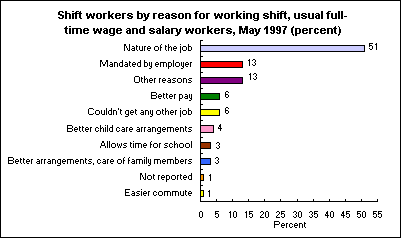
Among full-time employees who work an alternative shift, over half do so because of the nature of the job.
In May 1997, about 51 percent of full-time shift workers reported doing so because of the nature of their jobs. Examples are some jobs in manufacturing and many protective service jobs.
Roughly 13 percent of shift workers reported that they were on an alternative shift specifically because alternative shifts were mandated by their employer to meet transportation demand, management, or pollution abatement requirements.
It is apparent that few shift workers chose to work an alternative shift for the purpose of obtaining better compensation or to alleviate nonwork conflicts. Only about 6 percent reported working a shift for better pay. Approximately 4 percent of shift workers said they chose a shift to have better child care arrangements, 3 percent to have time for school, and 1 percent to have an easier commute.
"Alternative shift" and "shift work" both refer to work schedules that do not conform to the regular daytime schedule, for which work hours typically fall between 6 a.m. and 6 p.m. Types of alternative shifts include evening shift, night shift, rotating shift, and employer-arranged irregular schedule.
These data are a product of the May 1997 supplement to the Current Population Survey. Learn more about shift work in "Flexible schedules and shift work: replacing the 9-to-5 workday?" by Thomas M. Beers, Monthly Labor Review, June 2000.
Bureau of Labor Statistics, U.S. Department of Labor, The Economics Daily, Nature of job most frequent reason for shift work at https://www.bls.gov/opub/ted/2000/aug/wk3/art01.htm (visited May 17, 2024).