An official website of the United States government
 United States Department of Labor
An official website of the United States government
United States Department of Labor

The .gov means it's official.
Federal government websites often end in .gov or .mil. Before sharing sensitive information,
make sure you're on a federal government site.

The site is secure.
The
https:// ensures that you are connecting to the official website and that any
information you provide is encrypted and transmitted securely.
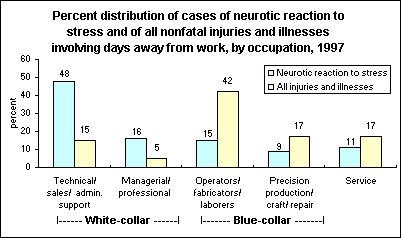
The majority of cases of occupational stress are experienced by white-collar workers. In 1997, close to two-thirds of cases of occupational stress involving days away from work occurred to workers in white-collar occupations.
[Chart data—TXT]
White-collar jobs fall into two broad categories: managerial and professional occupations and technical, sales, and administrative support occupations. Forty-eight percent of cases of occupational stress occurred to workers in technical, sales, and administrative support jobs, and 16 percent of stress cases occurred to those in managerial and professional jobs.
In contrast, over half of all nonfatal occupational injuries and illnesses are experienced by blue-collar workers. In particular, operators, fabricators, and laborers accounted for 42 percent of all nonfatal occupational injuries and illnesses in 1997, and workers in precision production, craft, and repair occupations accounted for 17 percent.
These data are a product of the BLS Safety and Health Statistics Program. Cases of occupational stress involving days away from work are classified by BLS as cases of "neurotic reaction to stress." Additional information is available from "Occupational Stress: Counts and Rates" (PDF 52K), by Timothy Webster and Bruce Bergman, Compensation and Working Conditions, Fall 1999. Farming, forestry, and fishing occupations are not represented on the chart because the statistic on neurotic reaction to stress for these occupations did not meet publication guidelines.
Bureau of Labor Statistics, U.S. Department of Labor, The Economics Daily, White-collar workers account for most cases of occupational stress at https://www.bls.gov/opub/ted/1999/oct/wk2/art03.htm (visited April 19, 2024).